Thursday, 15 March 2012

Yvette Mattern
'Global Rainbow'
March 2012
 
    My work, if 'messing about with your mates and being paid for it' counts as such, is installing art. The North East has been full of it of late, parts of which will form future posts, but by far the most spectacular, which I had no part of, is this work by
Yvette Mattern. It is the first of event of the 'Cultural Olympiad' 2012

    The premise is deceptively simple. Take some powerful lasers in the colours of the rainbow and project them across the night sky. Easy.

     But the result is something way beyond what that the above implies.


We visited the piece on March 1st, jouneying to the site where the lasers where situated - a car-park just north of Whitley Bay (no doubt much to the chagrin of the doggers with whom it is a popular spot)-  joining in the process a huge tailback of traffic that stretched some five miles from Tynemouth.

     At its point of origin the lasers are projecting a beam approximately two inches wide, but as the atmosphere takes over strange things happen. 


    Firstly the beams widen and blur to produce a more 'realistic' effect rainbow effect.


    This in itself depends on your position relative to it; for example the lines become wider the further under (and away) from them you are whereas should you be alongside it the beams are narrow. The range of the piece is also limited by things like water vapour- on the first of the five nights it was projected over Tyneside it was visible some thirty miles away, on night four the photographer Steven Appleby was able to capture it some sixty-two miles from its point of origin. This makes it 'interesting' for funders. There is no love lost between North and South Tyneside councils and it was requested that perhaps the artist could 'stop' the beams before it reached South Tyneside. No-one had the heart to tell them that light just doesn't work like that.

The Rainbow over South Shields. Oops!

    Perspective also pays a part. Directly under it the beams curve in an arc above you whereas straight on the beams appear to recede to a point on the horizon.

     All in all its a stunning piece. I believe Appleby's images are to be found on Facebook (an area of hell I avoid) and there is a group which tells you where the next showings are to be. There is also  a very extensive flickr group
here but nothing beats the real thing...


Saturday, 11 February 2012

The Stereoscopic 'Diableries'
of 19th Century France
 

     Some of you may be aware of my love of things stereoscopic and in particular the set(s) of images that are known as 'Diableries' (the Diabolical).

     These amusing cards which feature Satan and his skeletal cohorts riding bikes, at the concert hall, in the library and  performing many other jolly japes were created over a forty year period in France and were mainly published by Adolph Block. The exact number of images is unknown but it is thought to be around 140. The cards also have a
strong satirical edge, primarily at the expense of the Napoleonic excesses of the day, though some images still elude attempts to decipher them.

     The scenes themselves were made from clay and plaster, the stereoscopic photos of which became the cards. The French had  developed a technique now generally known as 'tissue view' in which each card was printed on thin paper and backed with tissue and coloured varnishes. Sometimes images where also pierced to allow white light through. Viewed from the front the image was in b/w but when  backlit it changed to colour. This was a delicate and expensive process and sets of images were thus luxury items.

     To date, only one (now rare) book exists on them; Jac Remises 'Diableries: La vie Quotidienne Chez Satan',  Balland, 1978). However, the
London Stereoscopic Company   has announced that they are to issue a new book on the subject at some point this year which will include the fruits of the considerable research that has taken place over the last twenty five years.

     Their website has a section devoted to the Diableries including
this link to an amazing page showing 73 of the Diableries in which the viewer can observe (at high resolution) the image in its front and backlit states.

     To get you in the mood here are a few single frames in b/w but do visit that link above to see them in their full colour glory.


Thursday, 5 January 2012

An Occult Calendar Of 1896
illustrated by Manuel Orazi

    Here is a item from the extensive collection of fantastic artworks available online from the archives of the Cornell University.

    It seems to have a semi-spoof written by author Austin De Croze (1866-1937), a writer better known for his cookery books, but its main interest lie in the  lithographs by Manuel Orazi (1860-1934).


    Orazi made his name in Paris in the early 1890s having moved there from Rome. His work is primarily Art Nouveau in style, and although he moved in interesting circles (for example with decadent author Jean Lorrain, Wilde and Proust) most of his illustrated work (which includes a version of 'Salome' as well as works by Poe and Baudelaire) is a bit tame for my taste. despite his personal interest in the occult. However there are some interesting items, for example this humorous depiction of a black mass featuring Maeterlinck, Proust, Wilde and Lord Alfred Douglas.


'Black Mass - Deception', cover for L'Assiette au beurre's
special issue on Black Magic, 13 December 1903
    In 1920 he was responsible for the set designs and costumes for the film adaptation by Jasques Feyder of a novel by Pierre Benoit, ' L’Atlantide'. The film is a mixture of the Atlantis myth with a dash of Rider Haggards' 'She'. Here are a few film stills.


Stacia Napierkowska as Queen Antinéa in Orazi designed costume

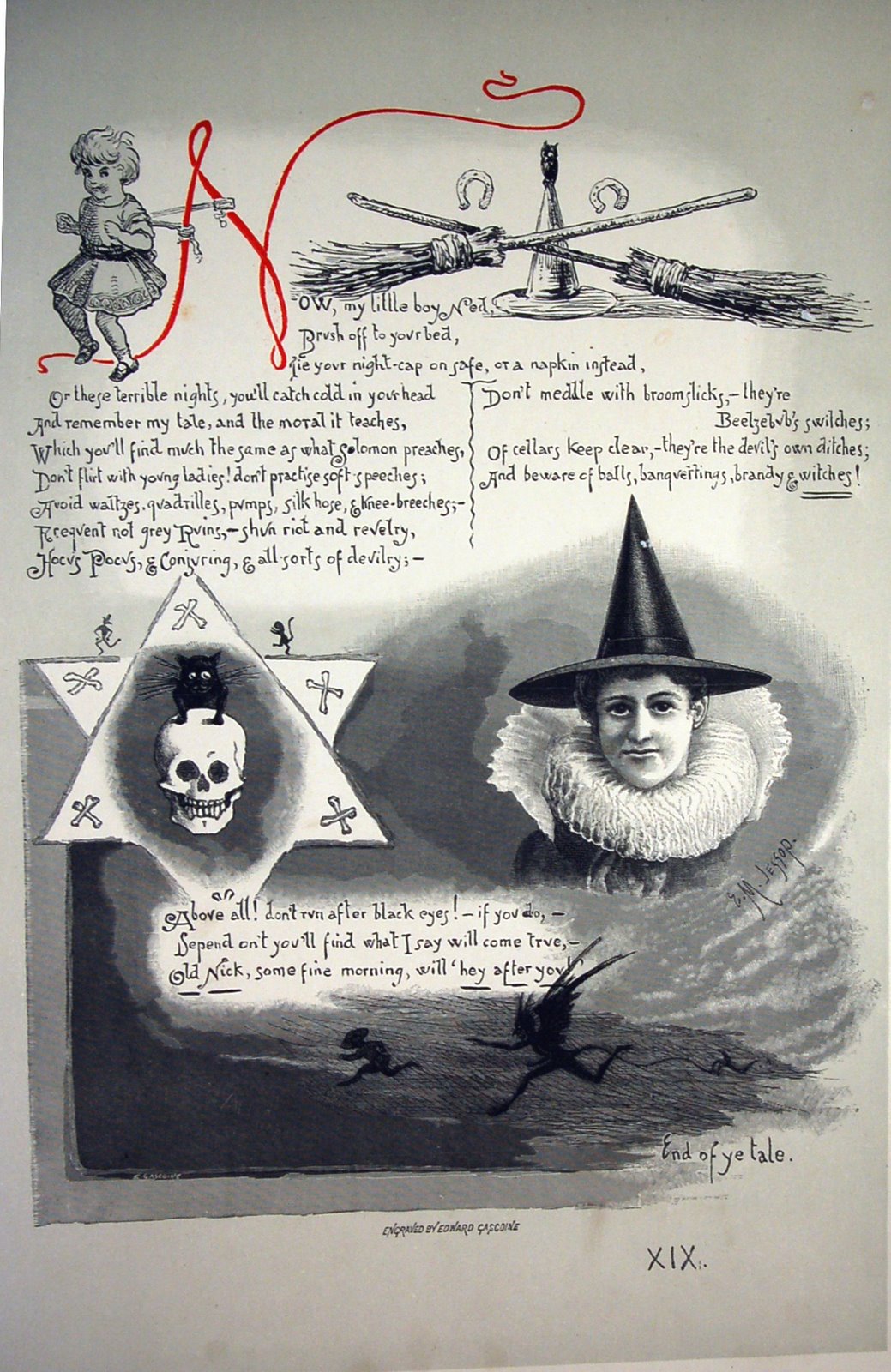
    But to the Calendar itself. It was  printed in Paris in 1896, supposedly printed in an edition of 777 copies (though this may well be part of a cabbalistic joke) with each double page spread mimicking the Christian calendar in some respect. It reminds me somewhat of a more macabre version of Ernest Jessops illustrations to Thomas Ingoldbys 'Witches Frolic' of 1888 which I will post next time. 


'The Witches Frolic' Illustration by Ernest Jessop 1888


Manuel Orazis' illustrations for
 An Occult Calendar Of 1896


Thursday, 15 December 2011

An Afternoon With Mel Gordon
(San Francisco 2nd Dec. 2011)

Mel Gordon in Professorial mode

    While in San Francisco it was my pleasure to meet Professor Mel Gordon. He is perhaps best known to the world at large via his numerous books, among them 'Voluptuous Panic: The Erotic World of Weimar Berlin', 'Erik Jan Hanussen: Hitler's Jewish Clairvoyant' and 'The Seven Addictions and Five Professions of
Three titles by Mel Gordon
Anita Berber: Weimar Berlin's Priestess of Depravity'. All are wonderfully, and extensively, illustrated from the authors own archives.


    I had become aware of Berber after obtaining the wonderful 'Gesamtskunstwerk Expressionismus' (I reviewed it 'here') and through that, the extraordinary book jointly penned with her husband Sebastian Droste 'Die Tänze des Lasters, Des Grauens Und Die Ekstase' (1923) which translates as 'Dances of Horror, Vice and Ecstasy'*. It is only a short internet jump to Profesor Gordons biography of Berber, the only one in

Tiburon Main St
English, and a very friendly correspondence ensued, resulting in a meeting for lunch in Tiburon. Tiburon has a touch of architectural fantasy about it - a fantasy in which an architect around 1980 decided to design a shopping mall in the styling of the 'ye old west'. Whist the results of this whim are somewhat odd, both the Mexican food and the views over the bay to downtown San Francisco are excellent, especially  so on a warm and sunny day in late November.


    While we ate, Mel told us many anecdotes concerning his Berber interests, including an account of his staging of  his Berber homage, based on his book and starring Nina Hagen in San Francisco in 1994. Against all his expectations it was a great success; so much so that some burly visitors who were arranging 'security' for the numerous vehicles outside ("cars get damaged Mr Gordon") asked for tickets as part of their payment, as they were impossible to obtain. Quite what they made of the unsimulated sex and drug taking that was part of the show is unknown.

    Dining done, we followed Mels car over the Richmond Bridge to his house in El Sobrante for tea cakes and of course...archive. After chosing cakes, I was handed a folio of erotic etchings of Berber made in 1919 by Charlotte Berend.  The copy I held was one of just 40 copies hand coloured and signed by the artist. As the entire run (80 copies) was suppressed as pornography and destroyed when found, it is an item of the utmost rarity. 

Side Real Press with the Berand folio.
    From then on there was a veritable blizzard of files, photos taken by visitors to the fleshpots of Berlin, guides to nude revues from the 1930s, the self-produced publications of various fascist love cults, Grand Guinol publicity material- the flow seemed endless. This was underpinned by Mels anecdotes on further diverse subjects; his conversations with people who had met Berber, the exact year Jewish humour began, the wonders of ebay, the latter years of Sebastian Droste as a self invented eccentric nobleman in New York and the theory (to which I wholly subscribe) that the ephemera of society is an often overlooked but integral part of its  history. It was hard to pay attention to such with my eyes wandering over the papers arrayed in front of me, and of course I forgot entirely to ask about Ewers, Alraune, and the actress Briget Helm all of which he had mentioned in passing at lunch.

Mel Gordon
    Suddenly it was after five o'clock and time for us to depart, but as a finale Mel fired up a laptop and showed me two twenty second clips of Anita Berber dancing. As no footage is known to exist of her outside her film works I was quite astonished by this, and viewed the clips a few more times as Berber dipped and drifted in grainy silence across the screen. These simple loops were quite magical to behold, and there is the tantalizing prospect that perhaps more footage might exist. A great end to a great afternoon.


    *'Dances of Horror, Vice and Ecstasy', translated by Merril Cole and containing an essay on the book by Mel Gordon, is due to be published by Side Real Press in early 2012. Details will be posted here.


Tuesday, 6 December 2011

Ajna, Anger and Techicolour Skull 
(Los Angeles 19th Nov. 2011)


Kenneth Anger / Technicolor Skull

    On our recent family visit to California we were able to spend a few days in L.A. 

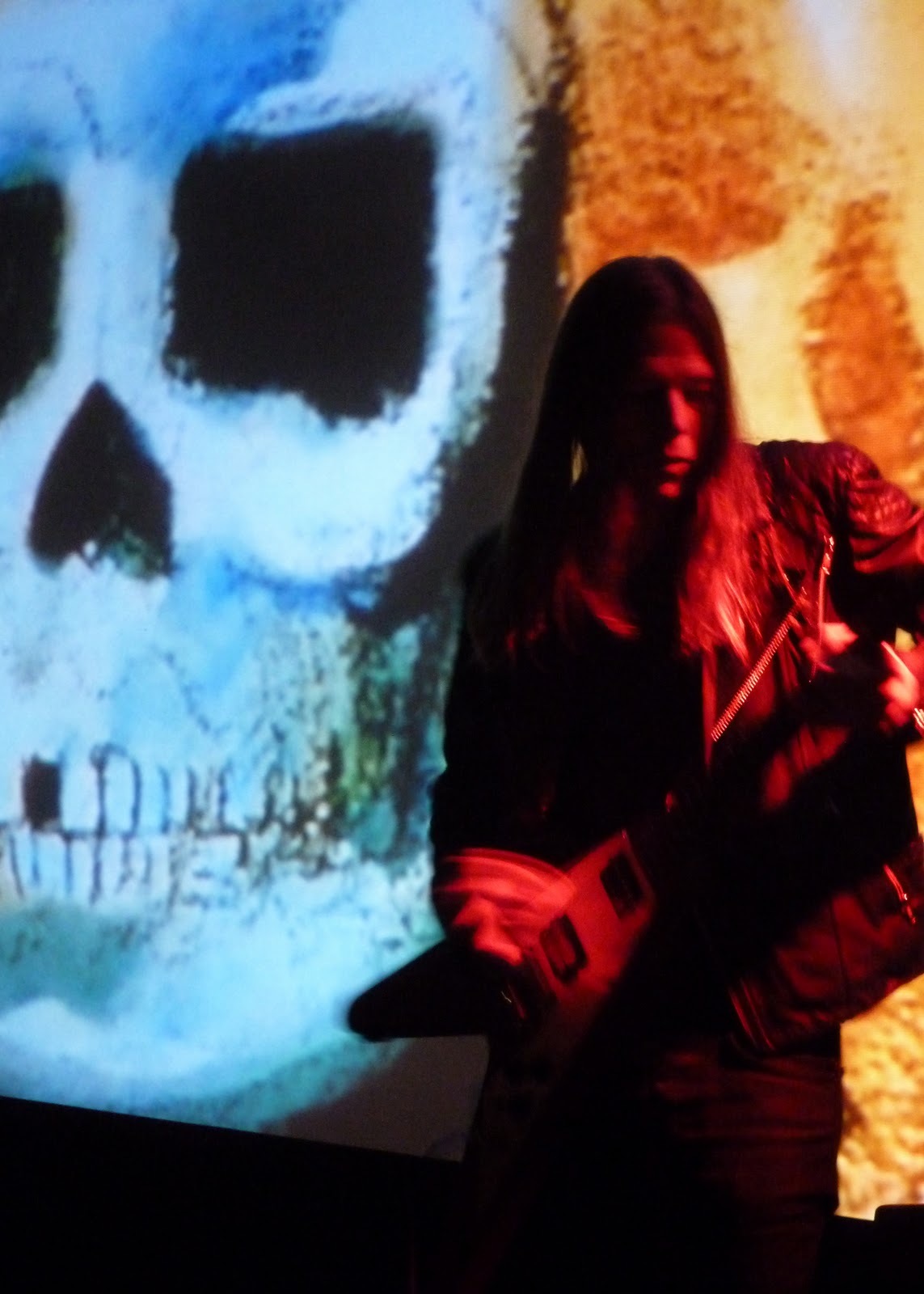
    The big event that weekend was the official opening of Kenneth Angers show 'Icons' at MOCA with a rare live performance by Brian Butlers band Techicolor Skull; a duo in which Butler pays guitar and Anger theremin.

L-R: Myself, Tyler and Chelsea Davis
    My pleasure was considerably enhanced by meeting Tyler Davis and his wife Chelsea of  The Ajna Offensive prior to, and at, the event. Tyler contributed an essay on the  mandrake to the Side Real Press edition of Alraune and Ajna have just released the debut Technicolor Skull album - they are busy folk.  As you might imagine, we had plenty in common and chatted over tea in a cafe opposite the juggernaut of indie music retail AmoebaThey normally reside in the rural hinterland of Oregon so it was very nice to be able to meet them in the flesh; they are a charming couple and good fun.

   Due to the kindness of Brian (we had previously met in Newcastle as part of the AV festival) I had been placed on the guest list and was also able to have a wander around the exhibition which is divided into two parts.

Brian Butler / Technicolor Skull
    The first is a large room filled with memorabilia from the Anger archive. As one might imagine, there is a considerable amount from the golden age of Hollywood; Valentino publicity photos, posters, newspaper clippings etc, but Anger has also assiduously collected ephemera from the more forgotten stars plus oddities such as a 'signed' Rin Tin Tin photo. This is the type of collecting (and collector) I admire the most - a jackdaws eye for things that others may pass up as too trivial but as a collection finds its worthy place. I was keeping an eye open for Crowley material, but this aspect of Angers interests was sadly not very evident.

    Room two (which was painted and carpeted in red) had a five screen installation showing films from The Magick Lantern Cycle. The relatively small size of the screens (perhaps 3m wide) allowed the audience to wander at will within the installation and at various points in time four of the five screens would freeze frame and the fifth would continue to run whatever film it was showing for a while. This  method worked really well as the element of chance determined what you saw at any particular time. The visuals and sound quality were, as one might expect for MOCA, excellent.

Kenneth Anger / Technicolor Skull
Brian Butler / Technicolor Skull
    The performance itself took place outside on a semi-piazza. It was packed with (one assumed to be) many of the great and the weird of the L.A. scene. To a backdrop compiled from various of Angers films, Butler created a wall of guitar treatments. This was deliberately restrained to allow the squawks and pitches of the theramin to both be heard and to play against them, the overall effect having a crackly feel to it that juxtaposed nicely with the film clips. It was short, perhaps fifteen minutes long. I think had it been much longer the energy generated would have been dissipated as the sound was quite intense.
Kenneth Anger / Technicolor Skull
    Both artists were available to chat and sign autographs after the show, but as I already had another commitment that evening I only managed to thank Brian and say my farewells to Tyler and Chelsea before sliding off into what is something of a rarity in L.A., a rainy night.