Thursday, 5 January 2012

An Occult Calendar Of 1896
illustrated by Manuel Orazi

    Here is a item from the extensive collection of fantastic artworks available online from the archives of the Cornell University.

    It seems to have a semi-spoof written by author Austin De Croze (1866-1937), a writer better known for his cookery books, but its main interest lie in the  lithographs by Manuel Orazi (1860-1934).


    Orazi made his name in Paris in the early 1890s having moved there from Rome. His work is primarily Art Nouveau in style, and although he moved in interesting circles (for example with decadent author Jean Lorrain, Wilde and Proust) most of his illustrated work (which includes a version of 'Salome' as well as works by Poe and Baudelaire) is a bit tame for my taste. despite his personal interest in the occult. However there are some interesting items, for example this humorous depiction of a black mass featuring Maeterlinck, Proust, Wilde and Lord Alfred Douglas.


'Black Mass - Deception', cover for L'Assiette au beurre's
special issue on Black Magic, 13 December 1903
    In 1920 he was responsible for the set designs and costumes for the film adaptation by Jasques Feyder of a novel by Pierre Benoit, ' L’Atlantide'. The film is a mixture of the Atlantis myth with a dash of Rider Haggards' 'She'. Here are a few film stills.


Stacia Napierkowska as Queen Antinéa in Orazi designed costume

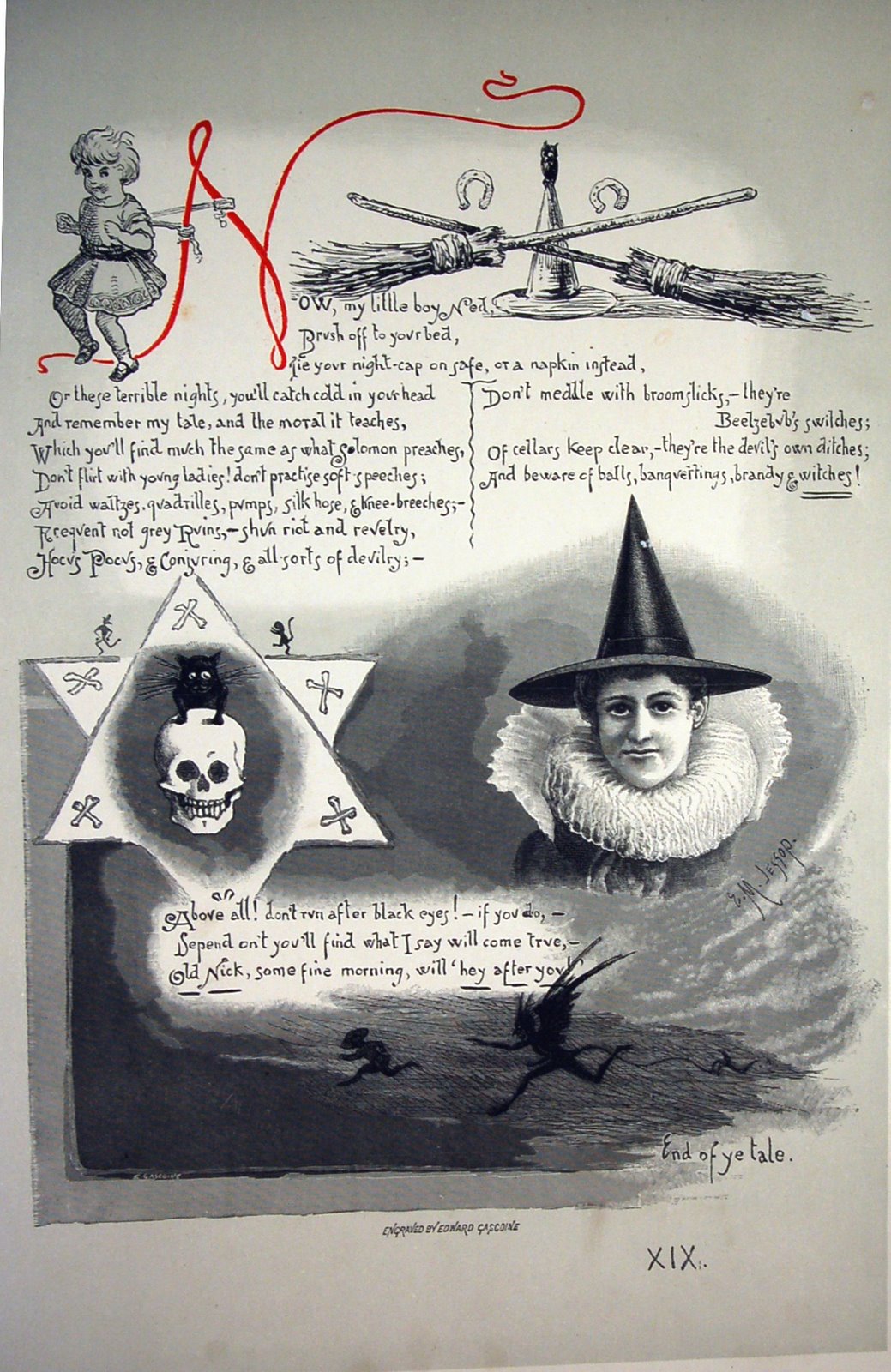
    But to the Calendar itself. It was  printed in Paris in 1896, supposedly printed in an edition of 777 copies (though this may well be part of a cabbalistic joke) with each double page spread mimicking the Christian calendar in some respect. It reminds me somewhat of a more macabre version of Ernest Jessops illustrations to Thomas Ingoldbys 'Witches Frolic' of 1888 which I will post next time. 


'The Witches Frolic' Illustration by Ernest Jessop 1888


Manuel Orazis' illustrations for
 An Occult Calendar Of 1896


Thursday, 15 December 2011

An Afternoon With Mel Gordon
(San Francisco 2nd Dec. 2011)

Mel Gordon in Professorial mode

    While in San Francisco it was my pleasure to meet Professor Mel Gordon. He is perhaps best known to the world at large via his numerous books, among them 'Voluptuous Panic: The Erotic World of Weimar Berlin', 'Erik Jan Hanussen: Hitler's Jewish Clairvoyant' and 'The Seven Addictions and Five Professions of
Three titles by Mel Gordon
Anita Berber: Weimar Berlin's Priestess of Depravity'. All are wonderfully, and extensively, illustrated from the authors own archives.


    I had become aware of Berber after obtaining the wonderful 'Gesamtskunstwerk Expressionismus' (I reviewed it 'here') and through that, the extraordinary book jointly penned with her husband Sebastian Droste 'Die Tänze des Lasters, Des Grauens Und Die Ekstase' (1923) which translates as 'Dances of Horror, Vice and Ecstasy'*. It is only a short internet jump to Profesor Gordons biography of Berber, the only one in

Tiburon Main St
English, and a very friendly correspondence ensued, resulting in a meeting for lunch in Tiburon. Tiburon has a touch of architectural fantasy about it - a fantasy in which an architect around 1980 decided to design a shopping mall in the styling of the 'ye old west'. Whist the results of this whim are somewhat odd, both the Mexican food and the views over the bay to downtown San Francisco are excellent, especially  so on a warm and sunny day in late November.


    While we ate, Mel told us many anecdotes concerning his Berber interests, including an account of his staging of  his Berber homage, based on his book and starring Nina Hagen in San Francisco in 1994. Against all his expectations it was a great success; so much so that some burly visitors who were arranging 'security' for the numerous vehicles outside ("cars get damaged Mr Gordon") asked for tickets as part of their payment, as they were impossible to obtain. Quite what they made of the unsimulated sex and drug taking that was part of the show is unknown.

    Dining done, we followed Mels car over the Richmond Bridge to his house in El Sobrante for tea cakes and of course...archive. After chosing cakes, I was handed a folio of erotic etchings of Berber made in 1919 by Charlotte Berend.  The copy I held was one of just 40 copies hand coloured and signed by the artist. As the entire run (80 copies) was suppressed as pornography and destroyed when found, it is an item of the utmost rarity. 

Side Real Press with the Berand folio.
    From then on there was a veritable blizzard of files, photos taken by visitors to the fleshpots of Berlin, guides to nude revues from the 1930s, the self-produced publications of various fascist love cults, Grand Guinol publicity material- the flow seemed endless. This was underpinned by Mels anecdotes on further diverse subjects; his conversations with people who had met Berber, the exact year Jewish humour began, the wonders of ebay, the latter years of Sebastian Droste as a self invented eccentric nobleman in New York and the theory (to which I wholly subscribe) that the ephemera of society is an often overlooked but integral part of its  history. It was hard to pay attention to such with my eyes wandering over the papers arrayed in front of me, and of course I forgot entirely to ask about Ewers, Alraune, and the actress Briget Helm all of which he had mentioned in passing at lunch.

Mel Gordon
    Suddenly it was after five o'clock and time for us to depart, but as a finale Mel fired up a laptop and showed me two twenty second clips of Anita Berber dancing. As no footage is known to exist of her outside her film works I was quite astonished by this, and viewed the clips a few more times as Berber dipped and drifted in grainy silence across the screen. These simple loops were quite magical to behold, and there is the tantalizing prospect that perhaps more footage might exist. A great end to a great afternoon.


    *'Dances of Horror, Vice and Ecstasy', translated by Merril Cole and containing an essay on the book by Mel Gordon, is due to be published by Side Real Press in early 2012. Details will be posted here.


Wednesday, 7 December 2011

The Hieroglyphic Press

 "We do not want the dregs of the 21st century, the 21st century is Nothing’s Empire. We want the High and the Holy, the Sacred, the Rare."
 

    It is always a pleasure to promote interesting projects  and this new press is certainly that.


       Run jointly by author Mark Samuals and a man well versed in the byways of European literature Daniel Corrick,  it aims to produce a biannual journal Sacrum Regnum, "an experimental journal, a sort of contemporary Symbolist review" and publish hitherto untranslated books by authors such as Guido Gozzano, Alexandra Macedonski and Stefan Grabinski

    I must confess that the first two names mean nothing to me, but with Grabinski and others on the list of "authors we hold in high esteem" (including Ernst Jünger, Stefan George, Charles Baudelaire, Bruno Schulz, Leon Bloy, Gustav Meyrink, and Gabriele d’Annunzio) they nail their colours to the mast.

    Their schedule of releases is set to begin in Spring 2012.


The website is here.